Do As The Elites Do
Plus: Chels on "Approved"
Welcome to the Crazy Insights newsletter, where everything we share is inspired by our readings, learning, and experiences. If you've just joined us, we're thrilled to have you on board 👋
“Watch what we do, not what we say.”
- John N. Mitchell (1913 - 1988)
No truer words have been spoken by a person in the corrdiors of power. 💯
THE CAT’S LAIR ☠️
Do As The Elites Do

In a previous article titled “Truth Lurks In The Shadows”, I touched on the dangers of sitting around waiting for the truth to fall into our lap. If we need to know the truth, we must take action. The truth comes to those who reach for it. This is the case in everything from our dating to professional lives. In the world of politics, seeking the truth is vital. If you sit on your hands, society’s greatest charlatans - aka politicians - will devour you whole. In this article, I will make a case for why you need to constantly cut through the noise to decipher the moves being made by your country’s political elites. If you know what those making the rules are actually doing, it might spare you a lot of future pain.
Over 11 years ago, in September 2014, the Naira to US Dollar (USD) exchange rate was hovering around ₦170/$1. At this point, everyday people like us were focused on saving our money in the bank. Some were investing. Some were starting businesses to generate more cash flow. All good moves. All revolving around growing our Naira net worth. However, in the upper echelons of Nigerian society, a certain group of people were making similar moves - but with one difference: They were focused on the US Dollar (USD), not their local currency. Today, the monies they invested that fateful September have returned at least 7.9x (21st April 2026 exchange rate = ₦1350/$1) their capital in Naira terms.
Let us assume you had ₦1,000,000 in cash at the start of the period and wanted to invest it. So you did what millions of regular Nigerians did back then (and still do): you invested in treasury bills (T-Bills). Given that T-Bills returned an average of 10.59% between 2008 and 2024, let’s say between September 2014 and April 2026, your money grew at a CAGR of 10.59%. Today, your precious ₦1,000,000 is worth ₦3,204,788, a 3.2x gain. However, by choosing to invest in Naira, you lost around 60% of your USD purchasing power. Your ₦1m was worth $5,882 at the start of the period. Today it is worth $2,374. It would have been better to lock up your funds in a USD domiciliary account paying 0% interest per annum. If you went this route, you would have ₦7,940,700 in your account today - approximately 2.5x the amount you garnered from your T-Bills strategy.
Let us assume I am the “elected” politician representing your zone in the Senate. I am corrupt like most Nigerian politicians. One day in September 2014, I stole ₦1,000,000. Please don’t laugh at me; it was a slow day at the office. Anyway, I know the local currency is doomed due to the 2014 global oil crisis. I have insider information, remember? So I quickly convert my loot to USD at a rate of around N170/$1. I now have $5,882 in my pocket in addition to the $3,000,000 I looted in the past 30 days. I then call up my banker in the US to invest in an S&P 500 Exchange-traded Fund (ETF). He goes for the SPDR S&P 500 ETF (Ticker: SPY). As far as financial moves go, this is pretty simple - ETFs were already popular in the US in 2014. SPY’s price is $197.02 per share on September 30th when I invest. Today, the share price is $713.94, so my funds have returned approximately 3.6x in under 12 years.
3.6x in 12 years does not look impressive until you look under the hood. That $5,882 is now worth $21,314. In Naira terms, this is ₦28,774,659 - a 28.7x return on my original ₦1,000,000. This is simplistic, though, because transfer and brokerage fees were completely removed from my calculations. But even if you account for fees, my returns as a corrupt politician still destroy yours. I did not even factor in the dividends from the ETF. This is what’s shocking here. You lost your USD purchasing power. I tripled mine. To make matters worse, I did not even run any complex financial strategy. SPY ETFs are as bare bones as they come. I just did what any noob in the US would do, and I completely outperformed you. My loot (₦28,774,659) is now worth 8.97 times your puny T-Bills investment.
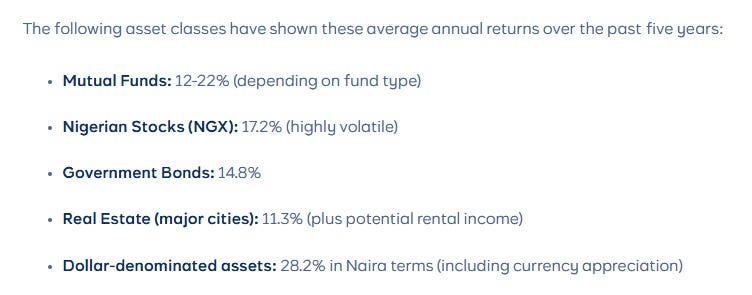
Cowrywise data on Investment returns from different asset classes (2020 - 2025)
You needed a 33.66% annual compound return in naira just to catch the corrupt man who dollarized once and did nothing extraordinary. Good luck matching that with a less or equally risky investment strategy.
If you had invested in the Nigerian Stock Exchange, you might have outperformed the corrupt politician. But the odds are slim. Few Nigerians invest in the stock market today, and only a handful did so back then. Less than 20 stocks are up 29x since 2014 (According to ChatGPT). You would have to be incredibly lucky to not only pick them but hold on to them for over 11 years. Would you have held through COVID? Be honest with yourself. If you invested in Bitcoin back then, you would be up 201.8x. However, back in 2014, how many Nigerians were aware of cryptocurrencies? Even among those who knew, how many didn’t lose funds to scammers, stolen wallets or centralised exchange hacks? In 2014, many of the fintech apps we know and love today were not available. There was a good chance you would have invested in T-Bills or mutual funds. Given this, it is inevitable that the elite running one of the simplest financial plays ever would have run circles around you.
As I reflect on this complete outperformance, I ask myself, “How did a lot of us fail to read the signs of the times?”
I think I have a simple answer to this question. We missed it because we were not actively trying to decipher the moves of those in power. The Naira has been losing value rapidly since the 1980s. The level of corruption has been rising. When funds are stolen, they are stashed abroad and stored in foreign currencies. Only rookie politicians loot and store in Naira. It’s also no secret that politicians use stolen funds to buy properties abroad. When they are sick, they also fly abroad. Given the number of things they do in foreign countries, one could decipher that the performance of the local currency is of little importance to them. They have most of their wealth tied to the Dollar, not the Naira. Duh! Most of us are aware of this. We also knew this at the time. We have known this for ages. If so, why did we not act?
Politicians and those in positions of power are very good at saying one thing and doing the opposite. They are experts at tying every facet of your social, economic, religious and political life to your identity. Your traditional ruler is constantly lording your culture and ancestry in your face. Your state governor is adept at inflating your pride at being an indigene of a state that was created virtually yesterday. Your president is constantly calling on you to be a good patriotic citizen. All these things are screens to distract you from the real moves they are making in broad daylight. 60 years ago, your state of origin was not on the map of a country that was created less than 120 years ago. Think about this deeply.
Many people saved only in Naira simply because the elites parroted that it was unpatriotic not to do so. Remember when our political elites were admonishing us for not using our hard-earned money to buy locally produced goods? Somehow, the Naira’s freefall was your fault because you have a “penchant” for foreign goods. Meanwhile, the same people will jet off to the UK each time they have a niggling sensation in their throats. You were also responsible for the Naira collapse in 2022-2023 because you were doing the same thing they were doing - converting your Naira into US Dollars. Until you free yourself from notions of honour ascribed by those in power, and instead do what they do, you may continually find yourself knee-deep in the problems they create.
Imagine this scenario in the business world: You want to invest in a company and are doing your due diligence. Somehow, you find out that the CEO, the rest of the executive team and the board members are offloading large amounts of shares every month. Will you still invest in said company? Most savvy investors will flee. If those running a company are not holding its shares, they have no skin in the game. If they are dumping shares, there is a high chance they have no faith in the company’s future. No one sells massively when they are bullish on the future, unless they want to buy back at a lower price. If this is the case, skilled investors will wait and buy at the lower price, the bigwigs are re-entering at. Either way, if those at the helm are not holding shares of their own company, it is not a sign to ignore. Who will pump the long-term price of the shares when the major holders who can are not even holding them?
Apply this same logic to Nigeria. If your politicians are not holding your own currency or investing in your stock market, you need to rethink your decision to go Naira-heavy. Unless you have a way to earn in Naira and achieve returns above inflation, you might be better off saving your money in the same currencies as your politicians. Why would they protect the value of your local currency when they are not even holding it? Gold had a very good 2025. It smashed through its all-time highs multiple times, and you likely hold none of it. Your senator probably has the precious metal in his portfolio. Along with commodity futures like Brent crude. While he profits from rising oil prices today, you suffer increased petrol pump prices. Meanwhile, he will pontificate on the need for you to hold your local man-made currency. While he continues to work with the country’s decision-makers to print more Naira out of thin air, further devaluing your net worth and impoverishing you.
Don’t let sentiment and so-called patriotism cloud your thinking.
Do as the elites do.
Just don’t copy the actual immoral things they do.
Interesting stuff:
Nobody Has A Personality Anymore (Article)
This movie scene moved me:
CHELS’ WORLD 🌍
Approved

So today, I had just gotten off an emotional call. It wasn’t a rant, but certain things came up that made me feel a bit off. I didn’t want to get into the habit of complaining about this particular person, because the only thing that complaint did was make me more resentful. It wasn’t a resentment that showed in my behavior yet. It just sat heavily on my chest.
Which meant it was a sin I kept confessing. Every time I did, my priest would say, “If you cannot make this person change, or this source of resentment cannot be taken off, then pray for the person.” If I am being truthful, I haven’t been doing that. And that has to change.
But let’s circle back to the gist.
I got off that call, went back to work, and someone chatted me: “I have a transaction in your queue, kindly approve.”
I was already typing: “This means that you’re not checking... if you were checking, you would have seen that I had approved.” As I was typing, I heard something. Not a visible voice. Just something dropping into my mind, saying: You shouldn’t send this. You’re not supposed to send this.
I was stubborn. I kept typing to the end. And it just kept dropping: Do not send this. Do not send this. I couldn’t be too stubborn, so I cleared everything and typed: “Approved, sir.”
You see that “sir”? That was not respect. That was me still trying to exert a bit of rebellion. So, I deleted it. But not before I said “God, stop now!” because I just wanted to transfer a bit of the hurt, I was feeling, and I wasn’t allowed to. I felt sorry immediately. I shouldn’t be telling God to stop. So, I deleted the “sir” and just sent “Approved.”
It wasn’t a visible voice, I could hear something, but it felt like the voice was in my head. I don’t fully know how to explain it. Whether they were thoughts God was dropping into my mind or my conscience speaking, I just knew the thoughts were coming like voices that were no voices. That’s the best way I can explain.
And that’s the point. The only way you keep hearing God in the big moments is to be obedient in the small ones. When He says, “Don’t do this, and you don’t”. When He says, “Don’t send this, and you don’t”. It’s not always easy, because there’s this warring in our spirits, this pull to just go our own way. I would rather have sent that message. I wanted to. But I didn’t.
Two things I took from this. One, the transfer of aggression helps nobody. That you’re angry or displeased by somebody doesn’t mean you should transfer that displeasure to someone who has absolutely no business enduring it. Two, God speaks; obedience in the little things is what keeps the channel open.
Now here’s where it gets interesting.
I was listening to The Brothers Karamazov by Dostoevsky. There’s a character named Mitya who, in a moment of rage and wounded pride, violently attacks a man living in poverty, a former army captain. That one act didn’t just humiliate the man. It scarred the captain’s young son. A ripple Mitya never saw coming, from a moment he probably told himself was justified.
My snarky message wasn’t a violent assault. But the mechanism is the same. Every time we vent on someone who had nothing to do with our bad morning, we’re practicing. And we become what we practice.
The Catholic Church teaches that there are ways we share in other people’s sins. This is exactly what that looks like.
Let me make it concrete (hypothetical). Let’s say I sent that message. He reads it, feels the sting, not enough to reply, but enough. It’s 3pm, everyone’s tired, everyone’s counting down. He goes back to work, but now something is sitting on his chest too. An hour later, someone asks him a routine question. He snaps. Not dramatically, just enough. That person logs off at closing time feeling some kind of way. They go home. Their partner asks a simple question, “How was your day?” and the answer comes out sharper than intended. Not a fight, just a chill. The kind that makes the other person go quiet and decide not to ask again tonight. And the child in that house who just wanted a present, available parent, gets a distracted and impatient one instead. The child doesn’t know why. They just feel it.
Nobody traced it back to me. But I made it possible.
Love has a requirement, that we remember we are our brother’s keeper. That we are all connected in ways we cannot always see. Being within your rights to do something doesn’t make it the right thing to do. Sometimes the most powerful choice is the charitable one. The one that costs you a little, so it doesn’t cost someone else a lot.
I found this interesting:
CURRENT READS 📚

The Cat: Shoe Dog (By Phil Knight)

Chels: The Last Letter (By Rebecca Yarros)
RANDOM STUFF 🎲